






For centuries, the phenomenon of strange sounds emanating from certain desert regions around the world, resembling music, has fascinated countless tourists and explorers.
Ancient people believed it could be the scream of demons from the underworld or the song of a mermaid luring sailors. However, with modern science, its true origin remains an unanswered question.
The haunting sounds of the desert
According to Xinhua News Agency, in 2022, Chinese scientists discovered a desert region emitting a strange buzzing sound along the coast of Hainan Province, China. The research team leader, Qu Jianjun, stated: “The discovery of this wondrous natural phenomenon fills a gap regarding unique coastal desert areas in China. This will support the development and protection of tourism resources on Hainan Island . “

With modern science, the true origin of the sounds in the desert remains an unanswered question.
This is not the first time scientists have discovered this mysterious phenomenon of the desert. During his travels, the explorer Marco Polo encountered a desert emitting haunting sounds that he believed to be those of “evil desert spirits.” Marco Polo described it as “sometimes filling the air with the sounds of all kinds of musical instruments, as well as drums and the clanging of instruments with arms.”
For centuries, scientists have sought various ways to explain this phenomenon, but there has been no definitive answer. For example, Charles Darwin was unable to explain the origin of the sound he heard in the Chilean desert.
Experts have named this phenomenon “singing sands .” Singing sands, also known as whistling sands or musical sands, are areas of sand in deserts or coastlines that can naturally produce sound in the wind due to a combination of physical characteristics such as the size and composition of the sand grains and the topography.
Searching for the solution
To date, researchers estimate that there are approximately 30 “singing deserts” in the Americas, Africa, and Asia. While there are various explanations, they generally agree on the hypothesis that vibrations occur beneath the surface of the sand dunes.
In a report recently published in the journal Geophysical Research Letters, a team of scientists from France has solved the mystery: how can these singing sand grains produce sound simultaneously?

Scientists conducted experiments on the phenomenon of “singing sand” in the laboratory. (Image: American Geophysical Union)
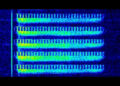
To answer this question, sound researchers conducted experiments at two different sand dunes: one in the Sahara Desert, southwest Morocco, and one near Al-Askharah – a coastal town in southeastern Oman, on the Arabian Peninsula. The results showed that in Morocco, many sand dunes produced a consistent frequency of 105 Hertz, while in Oman, a jarring, erratic noise with fluctuating frequencies, ranging from 90 to 150 Hertz, was sometimes present. Furthermore, while the sand in the Moroccan desert was relatively uniform in size, this was not the case in Oman.
By isolating particles of different sizes and recording the sounds they produce as they move through the air in a laboratory, scientists concluded that “singing sand” is a phenomenon dependent on the size and speed of the sand’s movement ; that is, particles of different sizes move at different velocities.
However, they still didn’t understand how such erratic movements could combine to create such coherent music. The widely accepted hypothesis is that the movement of the sand grains occurs simultaneously, or oscillates at the same frequency. Thousands of tiny vibrations combine to create a vibration in the air, which then produces sound, according to lead composer Simon Dagois-Bohy.