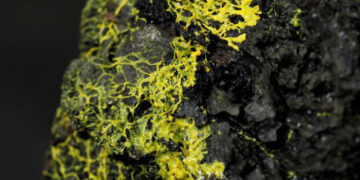







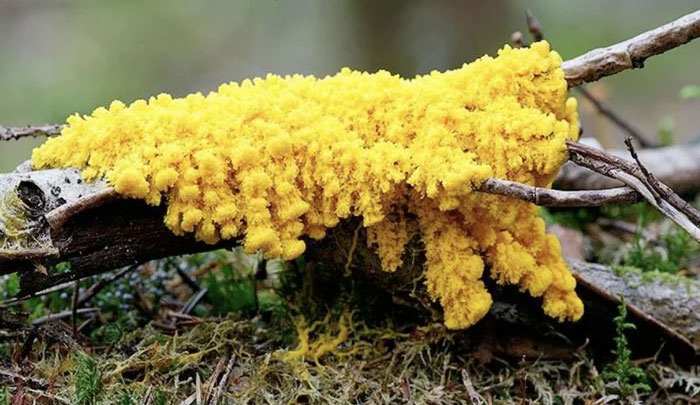
This is an organism that exists on our planet, however it is neither a plant nor an animal, nor is it a fungus .
People who identify as “different” from the socially accepted gender have become a major issue in our society. While the Western world is beginning to accept individuals who identify as different, many places still do not.
However, there is one creature on Earth that truly proves that gender is merely a social construct; it has nearly 720 genders ; it can move without legs or wings; and it can heal itself within 2 minutes if cut in half.
This organism has been named Physarum polucephalum , and it has been identified by biologists as a “self-sustaining and growing slime,” capable of exponential growth simply by using energy it absorbs from the atmosphere, such as moisture and sunlight.
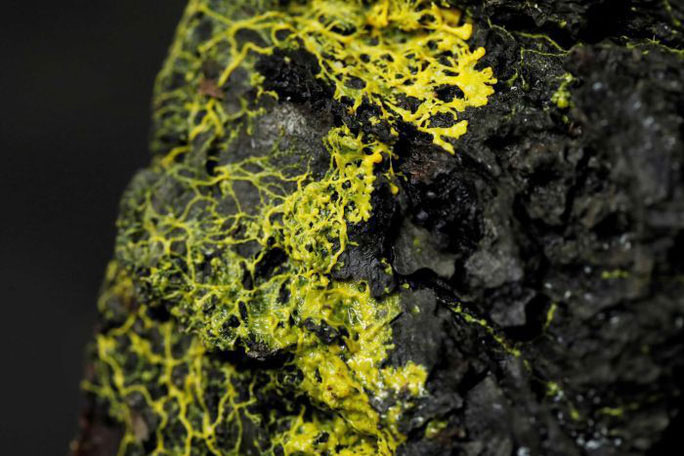
Physarum polycephalum resembles a sticky, yellow mass of wires. (Photo: Reuters).
While human sex cells are of two types, the organism has sex cells with multiple genes that can have many different combinations – there are 720 different combinations that can occur, but scientists are still working to identify and classify them all.
Physarum polycephalum began appearing in biological encyclopedias in the early 19th century. The organism itself was not properly analyzed or studied until 1930 when Frank L. Howard became fascinated by its growth patterns and the specimens it produced.
In 1931, Howard published an article titled “The Life History of Physarum polucephalum,” which can be found in the American Journal of Botany, Vol. 18.
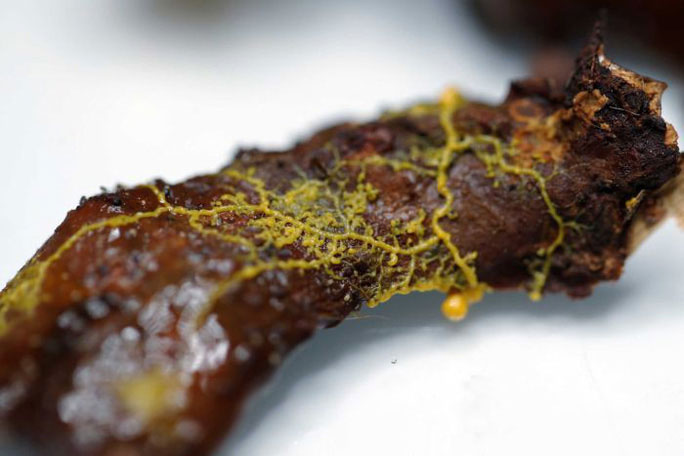
Studies have shown that Physarum polycephalum can actually follow its own slime trails to return to food sources for subsequent feedings. This suggests that this brainless organism possesses spatial memory and problem-solving abilities. (Photo: Reuters).
Besides the enormous number of sexes, what surprised Howard was that even though the creature lacked a brain, it still showed signs of intelligence and even learned by following different patterns. Even without eyes or ears, the creature was highly aware of its surroundings and would retreat if it sensed danger ahead.
In the 1960s, people began calling it “the blob,” inspired by a 1958 science fiction film called “The Blob”—an alien creature devouring everything in its path in a small town in Pennsylvania, USA.
Since then, many experiments have been conducted to better understand how the blob develops and grows.
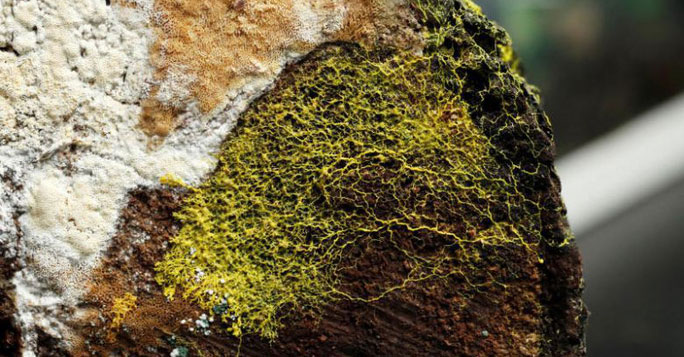
When two or more Physarum polycephalums merge, they can share what they have learned and continue to find the most efficient path to food. Sometimes, hundreds of individual Physarum polycephalums can combine into a giant “fused organism,” making decisions in a “hive mind” style (a collective mind – the sharing of intelligence within a group). (Photo: Reuters).
A 2016 study showed that even a brainless organism could be more intelligent than most organisms with brains. This organism was placed in various mazes and each time it easily found its way out. This led scientists to view intelligence in a different light, suggesting that it might not be directly linked to the brain, but rather something more closely related to the entity that gives life to everything.
In their normal state, the blobs are quite still, resembling single-celled amoebas. But when they combine, they create a larger structure, covering a surface area of several square meters.